Veda: full-attention tile distillation for video DiTs.
90% sparsity at perceptual parity. 95% sparse 720P generation:
19.4 min → 3.8 min. 5.1× end-to-end acceleration.
Max-pooled full attention provides a tile-level teacher distribution. KL distillation aligns Veda with the dense attention geometry before the binary sparse mask is materialized.
Per-layer, per-head tile shapes (pt, ph, pw) adapt the tile geometry to heterogeneous spatial and temporal attention heads under a fixed hardware budget.
A ThunderKittens kernel fetches only selected K/V tiles via TMA and overlaps sparse gathers with WGMMA compute, turning structural sparsity into wall-clock acceleration.
Human side-by-side evaluation on WaverBench1.0, a 304-prompt benchmark centered on object motion, camera motion, and temporal consistency, together with latency under identical sparse-kernel infrastructure. Use the human-study tabs to switch comparison targets.
Per-layer latency is reported against FlashAttention-3 at 720P and 480P across Waver and Wan2.1. The accounting includes MLP, mask preparation, and sparse-kernel execution, so the gain is measured at the layer level rather than inferred from FLOPs.
Prompt- and seed-paired generations isolate the effect of the attention operator. Drag the handle to compare geometry, motion, and prompt alignment; select clips from the thumbnails below.
All clips are generated with Veda. We use 90% sparsity for Waver-T2V-1B at 480P / 81 frames, and 95% sparsity for Waver-T2V-12B at 720P / 241 frames. Across portraits, animals, landscapes, sports, robotics, and cinematic camera motion, these samples show that Veda preserves scene structure and temporal coherence across diverse generation regimes. Click any clip to enlarge.
The central question is not how many tiles can be removed, but whether the retained mask preserves the tile-wise attention structure induced by the dense softmax distribution.
When sparsity exceeds the moderate regime, prior sparse-attention methods do not simply lose texture or prompt fidelity. They produce a distinct failure mode: water-ripple warping across surfaces, local geometric distortion, and temporal flicker between adjacent frames. These artifacts indicate broken spatiotemporal connectivity in the attention graph, rather than ordinary semantic hallucination from the dense generator.
To separate sparsity from mask quality, we hold the budget fixed at 90% sparsity and change only the selected tile mask. The Oracle mask, obtained by max-pooling the full-attention map and retaining the high-response key tiles for each query tile, preserves high-fidelity structure. Average pooling, under the same budget, fails. This controlled comparison shows that degradation is governed by structural alignment with full attention. Tile recall makes the gap measurable: Veda recovers 66.4% of oracle-selected tiles, whereas average pooling recovers 34.2%.

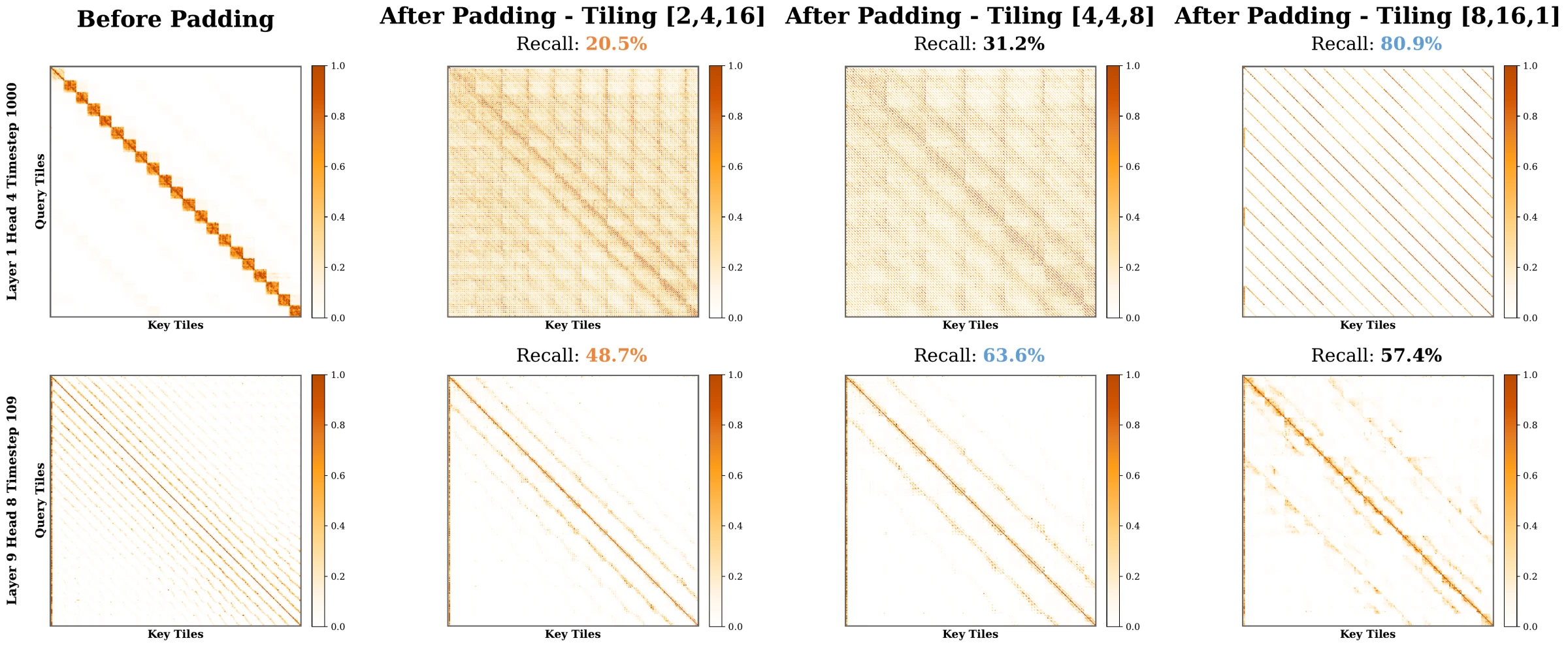
Video DiT heads are not exchangeable. Some heads concentrate on local spatial structure, while others connect temporally distant regions; these patterns also evolve across diffusion timesteps. A uniform tile layout can split high-affinity neighborhoods for one head and merge unrelated tokens for another, increasing intra-tile variance and reducing oracle-mask recall.
[4,4,8]: +9.5% Overall, +7.2% Motion.The derivation follows the view of attention as a probability distribution over keys: the softmax row is not just a heuristic normalization, but an entropy-regularized geometry that must be preserved before sparsification.
For one query, attention is the gradient of a Log-Sum-Exp potential over logits uj = q·kj. Equivalently, each row is an entropy-regularized transport distribution over keys: it balances similarity to the query with entropy. Dropping a dominant key therefore changes the normalization constant rather than adding a small local perturbation. The remaining keys are renormalized by Z/Ẑ > 1, so probability mass is reassigned to lower-energy or irrelevant tokens. At video scale, this produces coherent structural errors: the sparse model follows the wrong connectivity graph with high confidence.
Ψ(u)=τ·log Σj exp(uj/τ) ⟹ P̃j = (Z / Ẑ) · Pj > Pj
A tile score must be estimated from compressed query and key representations. Average pooling preserves only the centroid. However, the dot product decomposes into a mean-product term and a covariance term; two tiles with similar means can still have different high-frequency structure and therefore different attention scores. Veda augments the mean with extrema. By the Bhatia-Davis inequality, the variance of a bounded variable is controlled by its mean, maximum, and minimum, so {avg, max, min} provides a compact estimate of both centroid and spread.
q·k = d·μqμk + d·Cov(q,k) · σ² ≤ (M−μ)(μ−m)
Let each token be decomposed into a tile mean plus a residual. The score error induced by compressing a tile is bounded by the product of query- and key-side intra-tile standard deviations. Under 3D RoPE, video tokens lie on a spatiotemporal manifold, but different heads induce different anisotropic metrics on that manifold. A fixed raster layout can scatter high-affinity temporal neighbors or merge unrelated spatial regions. Head-Aware Tiling searches (pt, ph, pw) per head, minimizing the sparse-output error and reducing the variance term that controls score estimation.
E = |Σi ⟨rqi, rki⟩| ≤ B · σq · σk
Top-k selection is discrete, but the attention distribution that induces it is continuous. Veda therefore supervises the estimator before thresholding: max-pooled full attention defines the target tile distribution, and the estimator produces a soft distribution over key tiles. Minimizing row-wise KL divergence aligns the information geometry of the predicted distribution with the full-attention teacher. Locally, KL is a Fisher-weighted quadratic form, so errors are penalized in the natural geometry of the simplex rather than in raw Euclidean score space. After this continuous alignment, Top-k selection can be applied as a hardware-executable binary mask.
Ldistill = DKL(Atgt || Apred) ≈ 1/2 · ΔθTI(θ)Δθ
Stable high-sparsity attention requires four aligned choices: preserve the oracle attention structure, estimate tile scores with sufficient statistics, group tokens with head-aware low-variance tilings, and distill the dense probability geometry before Top-k discretization. Veda combines these conditions to match full attention at 90% sparsity on WaverBench1.0 and scale to 95% sparsity for 720P / 241-frame generation.
@inproceedings{han2026veda, title = {Veda: Scalable Video Diffusion via Distilled Sparse Attention}, author = {Han, Shihao and Yang, Hao and Mei, Xiaofeng and Hu, Xinting and Jiang, Yi and Qi, Xiaojuan}, booktitle = {International Conference on Machine Learning (ICML)}, year = {2026} }